
How alcohol affects blood pressure
Alcohol and blood pressure have a dose-dependent relationship. The more you drink, the more your blood pressure rises. This is one of the most well-established findings in cardiovascular research, confirmed across dozens of large population studies over decades.
When you drink, several things happen in your body that push blood pressure up:
- Sympathetic nervous system activation: Alcohol stimulates the release of adrenaline, which constricts blood vessels and increases heart rate.
- Cortisol increase: Alcohol raises cortisol levels, a stress hormone that promotes sodium retention and vasoconstriction.
- Baroreceptor impairment: The pressure sensors in your blood vessels become less sensitive, reducing the body's ability to regulate blood pressure in response to changes.
- Sodium and water retention: The kidneys retain more sodium when alcohol is present, increasing blood volume.
- Endothelial damage: Over time, regular heavy drinking damages the lining of blood vessels, reducing their ability to dilate and increasing stiffness.
Drinking levels and blood pressure risk
| Daily Intake | Standard Drinks | BP Effect | Cardiovascular Risk |
|---|---|---|---|
| None | 0 | No alcohol-related BP impact | Baseline risk |
| Light | 0.5-1 drink | Minimal short-term; debatable long-term | No proven benefit despite old claims |
| Moderate | 1-2 drinks | +2-5 mmHg systolic with regular use | Slightly elevated; dose-dependent |
| Heavy | 3-4 drinks | +5-10 mmHg systolic | Significantly increased risk of hypertension, stroke, heart failure |
| Binge (single session) | 4-5+ drinks | +10-15 mmHg acute spike | Sharply increased short-term risk of stroke and arrhythmia |
A standard drink is 14 grams of pure alcohol: roughly 12 oz of beer (5%), 5 oz of wine (12%), or 1.5 oz of spirits (40%). Many people underestimate how much they actually drink. A large glass of wine at a restaurant is often 8-10 oz, which counts as nearly 2 standard drinks.
Alcohol accounts for 16% of hypertension cases
The myth of heart-healthy red wine
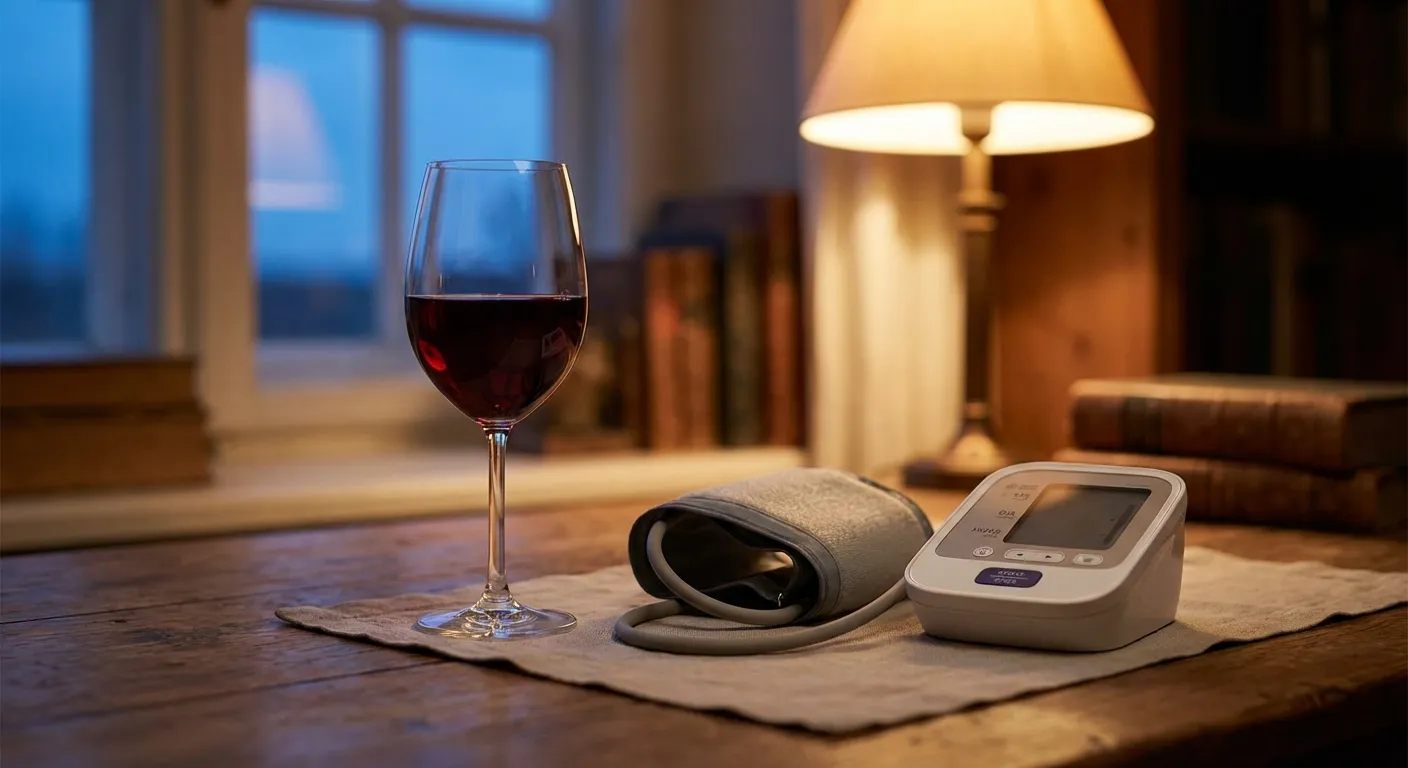
For years, the idea persisted that moderate red wine consumption was good for the heart. This was based on the "French Paradox": the observation that French people had relatively low heart disease rates despite a high-fat diet. Red wine, with its resveratrol and polyphenols, got the credit.
That narrative has fallen apart. Here is what more recent and more rigorous research shows:
- A 2023 analysis of nearly 600,000 people published in The Lancet found that any level of alcohol consumption increases cardiovascular risk. The protective effects seen in earlier studies were likely due to "sick-quitter bias" (former drinkers who quit due to health problems being counted as non-drinkers).
- The amount of resveratrol in a glass of red wine is too small to produce any measurable health effect. You would need to drink hundreds of glasses daily to reach the doses used in animal studies that showed benefits.
- The World Heart Federation issued a statement in 2022 explicitly saying there is no safe level of alcohol consumption for cardiovascular health.
This does not mean you cannot enjoy a glass of wine. But it should not be justified as "good for the heart." The cardiovascular cost, however small per drink, exists.
Alcohol and blood pressure medication
Mixing alcohol with blood pressure medication creates unpredictable effects. Here is how different medication classes interact:
| Medication | Interaction With Alcohol | Risk Level |
|---|---|---|
| ACE inhibitors (lisinopril) | Alcohol amplifies BP-lowering effect; may cause dizziness | Moderate |
| ARBs (losartan) | Similar to ACE inhibitors; increased dizziness risk | Moderate |
| Beta-blockers (metoprolol) | Alcohol masks low blood sugar symptoms; additive sedation | Moderate |
| Calcium channel blockers (amlodipine) | Alcohol increases absorption of some types; unpredictable BP drops | Moderate |
| Alpha-blockers (doxazosin) | Strong additive effect; high fainting risk | High |
| Diuretics (HCTZ) | Both cause dehydration; increased dizziness and electrolyte loss | High |
| Nitrates (nitroglycerin) | Dangerous blood pressure drops; do not combine | Very high |
The general rule: if you take blood pressure medication, limit yourself to 1 drink and never binge drink. The combination of medication plus alcohol can cause sudden blood pressure drops when you stand up (orthostatic hypotension), leading to falls, especially in older adults.
How cutting back affects your numbers
The evidence here is strong and consistent: reducing alcohol intake lowers blood pressure. The effect is dose-dependent, meaning the more you cut, the more your pressure drops.
- Heavy to moderate: Reducing from 3-4 drinks per day to 1-2 can lower systolic pressure by 3-5 mmHg within 2-4 weeks.
- Moderate to zero: Further reduction may lower systolic by another 1-3 mmHg, though the marginal benefit is smaller.
- Binge drinker stopping binges: Eliminating binge episodes removes the acute spikes that are the most dangerous pattern. Blood pressure variability decreases significantly.
Track your readings before and after reducing intake using a blood pressure log. You may be surprised how quickly the numbers respond. Some people see measurable changes within the first week.
Do not quit suddenly if you drink heavily
Practical guidelines
If you have normal blood pressure
- Stick to the recommended limits: 1 drink/day for women, 2 for men
- Avoid binge drinking, which causes acute blood pressure spikes
- Monitor your blood pressure annually to catch any trends
If you have hypertension
- Consider reducing to 1 drink per day or less
- Combine with other lifestyle changes ( diet, exercise, sodium reduction) for maximum effect
- Ask your doctor how alcohol interacts with your specific medication
- Never skip blood pressure medication because you plan to drink
- Track your readings on drinking vs non-drinking days to see the personal impact
If you are a heavy drinker
- Reducing intake may be the single most effective thing you can do for your blood pressure
- Taper gradually, do not quit cold turkey
- Talk to your doctor about support options
- Use a hypertension tracker to see the improvement as motivation
The bottom line
Alcohol raises blood pressure. The relationship is clear, dose-dependent, and reversible. The old idea that moderate drinking protects the heart has not held up under rigorous scrutiny. For people with hypertension, cutting back on alcohol is one of the most effective and fastest-acting lifestyle changes available.
You do not have to become a teetotaler. But knowing exactly how your drinking patterns affect your numbers helps you make informed decisions. Track a few weeks of blood pressure readings alongside your drinking, and let the data speak for itself.